
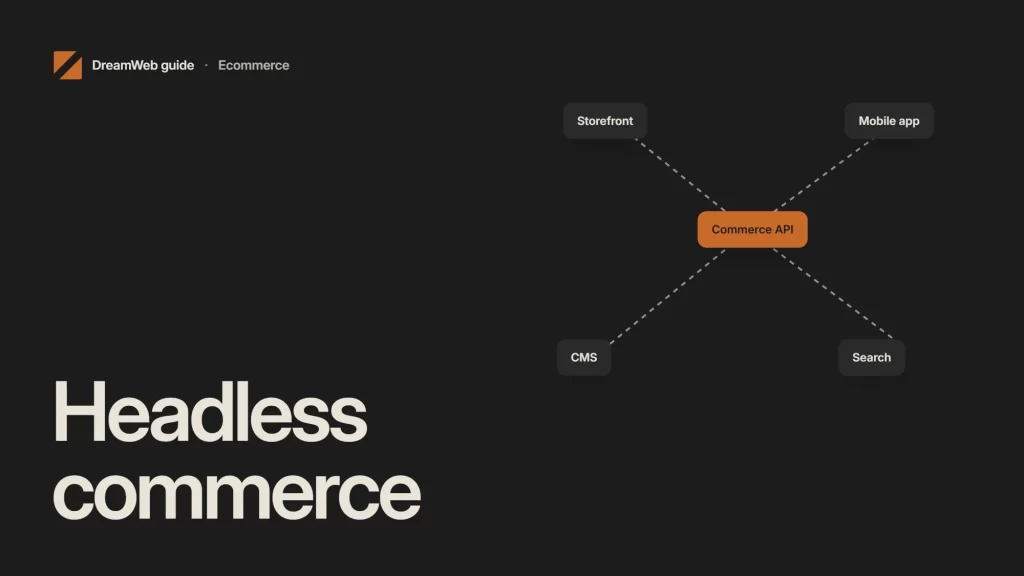
A headless ecommerce agency separates the customer-facing storefront from the commerce platform behind it. That freedom can solve real experience and architecture constraints. It also creates more software, integrations and operational responsibility.
Headless is not a quality tier. It is an architecture choice.
When headless commerce makes sense
Consider it when a standard theme and supported apps cannot deliver a required customer experience, content model, channel, performance target or system architecture.
Good reasons can include:
- one commerce backend serving several customer touchpoints;
- complex content and product experiences across platforms;
- a frontend that must integrate deeply with existing systems;
- unusual interaction or localisation requirements;
- teams with the engineering capacity to own a custom application.
Shopify’s guidance says to consider a custom storefront when the desired architecture, business process or customer experience cannot be achieved through existing channels, themes and apps.
“It sounds modern” is not a good reason.
What the agency should investigate
Discovery needs to cover the whole operating model:
- customer journeys and channel requirements;
- catalogue, pricing, inventory and promotions;
- cart, checkout, accounts and international rules;
- CMS and editorial workflow;
- search, recommendations and personalisation;
- ERP, CRM, fulfilment and customer-service systems;
- hosting, observability, security and deployment;
- SEO rendering, URLs, metadata and structured data;
- ownership, support and total cost.
The agency should compare a headless build with a well-engineered conventional storefront. Sometimes the smaller route solves the problem.
The delivery process
Architecture and boundaries
Define which platform owns products, content, customers, orders and presentation. Write down API limits, data contracts, caching, failure behaviour and recovery.
Shopify’s Storefront API exposes commerce capabilities for custom experiences. The frontend still needs production-grade handling for versioning, authentication, carts and changing data.
Experience and content
Prototype the priority journeys with realistic products and content. Check mobile, accessibility, localisation and edge cases before investing in component polish.
Engineering and integration
Build reusable components, automated tests, preview environments and deployment controls. Make third-party failure visible. A fast custom frontend is not resilient if one service can silently break product availability or checkout.
SEO and migration
Agree server rendering or other discoverable output, canonical URLs, redirects, sitemaps, structured data and internal links. Test the rendered HTML and live responses rather than relying on framework defaults.
Handover and operation
Document source ownership, environments, releases, monitoring, incident response, platform upgrades and editor workflows. Headless systems need a maintained product team, not only a launch supplier.
Trade-offs to price honestly
Headless can provide design freedom, channel reuse and cleaner separation between systems. The cost is custom engineering, more integrations, more testing and a larger support surface.
Ask for a three-year operating view, not only build cost. Include hosting, APIs, licences, maintenance, on-call support and the people needed to keep the system current.
What a good proposal includes
Expect an architecture diagram, responsibility matrix, API and data inventory, accessibility and performance targets, SEO plan, testing strategy, launch controls, support model and explicit exclusions.
A short buyer check
Start with the hard part. It may be a large product list, a slow old site, many local markets or a need to share stock with other tools. Say what is hard in plain words.
For example, ask if a simple theme can solve the job. If not, ask which part needs a new front end and why. Who owns the API? Who pays for it? What fails if it is down?
Keep the first design small. Test the risk first. A headless build is useful when the extra work has a clear job to do.
DreamWeb’s work covers Shopify, WooCommerce and custom product experiences. That range matters because the recommendation should follow the constraint, not the agency’s favourite stack. Start with WooCommerce agency UK if platform choice is still open, or ask DreamWeb to compare the smallest viable architectures.
Related reading: Shopify ecommerce development company and Page speed optimization service.