
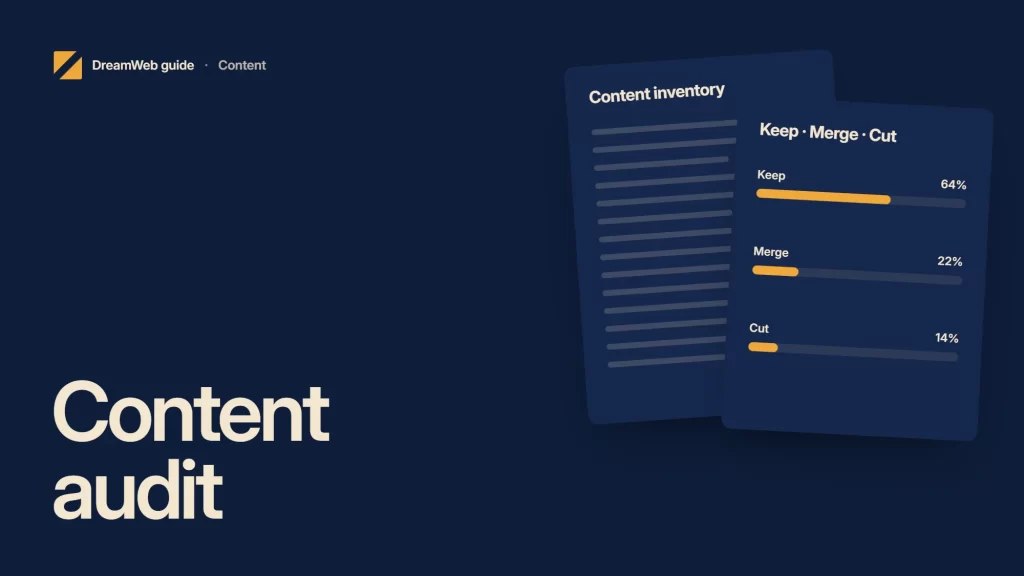
A content audit agency should help you decide what every important page is for and what happens to it next. The result should be a controlled plan to keep, improve, combine, redirect or remove content—not a spreadsheet with hundreds of URLs and no ownership.
When a content audit is needed
Commission an audit when the website has grown through several teams, campaigns, migrations or acquisitions. Typical signs are:
- several pages answer the same question;
- important information is outdated or contradictory;
- navigation reflects internal departments rather than user tasks;
- organic traffic is spread across competing URLs;
- editors cannot tell which page is authoritative;
- redesign or migration scope is being estimated without an inventory;
- useful content exists but is hard to find.
The earlier this work happens in a redesign, the better. Empty-template design hides the content decisions that later delay migration.
What the agency should audit
The inventory normally records URL, title, template, status, owner, intended audience, primary task, traffic, search visibility, conversions, links, freshness, accuracy, accessibility and technical indexability.
Not every field needs a score. Scores can create false precision. The point is to gather enough evidence to make a defensible decision.
GOV.UK’s transition guidance recommends using analytics, user research and customer insight to identify content that is highly used, outdated or duplicated. Its content-audit guidance is useful because it links the audit directly to publication decisions.
A practical content audit process
1. Lock the scope
Decide which domains, subdomains, documents, languages and content states are included. Keep live, draft, archived and proposed material separate.
2. Crawl and reconcile the inventory
Combine the public crawl with CMS exports, sitemaps, analytics landing pages and Search Console data. No single source is complete. A CMS can contain unpublished drafts; analytics can reveal orphan URLs; a crawl shows what can be reached now.
3. Define page ownership
Every indexable page should have a clear primary intent. Record the canonical owner for each important topic and the supporting pages that link to it.
This is where cannibalisation becomes a governance problem rather than a keyword problem. If two teams believe they own the same question, the site will keep recreating overlap.
4. Review quality and evidence
Check whether the page answers the user’s task, reflects the current offer, uses approved claims, contains accessible media and provides a useful next step.
Google’s people-first guidance asks whether a reader leaves feeling they learned enough to achieve their goal. Use that as a practical editorial test.
5. Make a disposition decision
Use a controlled set of outcomes:
- Keep: accurate, useful and clearly owned.
- Improve: right owner, weak execution or evidence.
- Merge: overlapping pages should become one stronger owner.
- Redirect: the old URL has value but no longer needs separate content.
- Remove: no user need, evidence or continuing obligation.
- Review: a named decision-maker must resolve an open question.
“Delete because traffic is low” is not enough. A low-traffic policy, support or conversion page may still be essential.
6. Sequence the work
Prioritise high-value pages, risky inaccuracies, duplication and dependencies. Assign an owner, writer, reviewer and deadline. Record redirect and internal-link changes alongside copy work.
Quantitative, qualitative or both?
Analytics helps find scale and behaviour. Search data reveals queries and landing pages. A manual review finds accuracy, usefulness, tone and compliance issues.
You need all three. A page with little traffic may be an orphan with strong demand potential. A high-traffic page may answer the wrong question and create support demand. Data points to the page; editorial and user evidence explain the decision.
What you should receive
A useful agency handover includes:
- a reconciled URL and content inventory;
- a source-and-assumption register;
- a page-ownership map;
- keep, improve, merge, redirect and remove decisions;
- redirect and internal-link requirements;
- a prioritised production backlog;
- governance for future publication and review;
- a concise summary of risk, effort and opportunity.
Ask for the working files. The audit should remain usable after the presentation meeting.
Protect search performance during consolidation
When pages are merged or URLs change, preserve useful content, update internal links, set a relevant permanent redirect and check the new page’s canonical and indexability. Google’s site-move guidance warns against sending many old pages to an irrelevant destination such as the homepage.
Track the old and new URLs in Search Console and analytics after release. Consolidation is complete when users and search engines reach the intended owner, not when the spreadsheet says “done”.
DreamWeb’s website redesign brief makes content ownership, migration and definition of done explicit before build work starts. If your estate has grown without that control, ask DreamWeb to turn the inventory into an owned plan.
Related reading: SEO copywriting agency and SEO audit services.