
An SEO website migration consultant protects the search demand, links, content and measurement attached to your current URLs while the website changes underneath them. The role is part strategist, part investigator and part launch controller.
The consultant cannot promise that rankings will never move. Google says significant site changes can cause temporary fluctuations while pages are recrawled and reindexed. What the consultant can do is remove avoidable loss and prove that the migration was implemented as planned.
When you need migration support
Bring in a specialist when you are changing:
- domain or subdomain;
- HTTP to HTTPS;
- CMS or ecommerce platform;
- URL structure or taxonomy;
- several sites into one;
- navigation and large sections of content;
- rendering technology or a headless frontend;
- international or multilingual setup.
The highest-risk projects change platform, design, content and URLs at the same time. Google’s site-move guidance recommends changing one major thing at a time where possible.
What the consultant should do before launch
Create the source-of-truth inventory
Collect current URLs from crawls, XML sitemaps, the CMS, analytics, Search Console, backlink data and server logs where available. Reconcile the differences.
This inventory identifies pages that matter even if they are no longer linked from navigation.
Decide the future of every valuable URL
Each URL needs a destination or an intentional error state. The choices are usually retain, improve, merge, redirect or remove.
A redirect is not a disposal chute. It should take the visitor to the closest relevant replacement. Google advises against redirecting many unrelated pages to the homepage because that can confuse users and be treated as a soft 404.
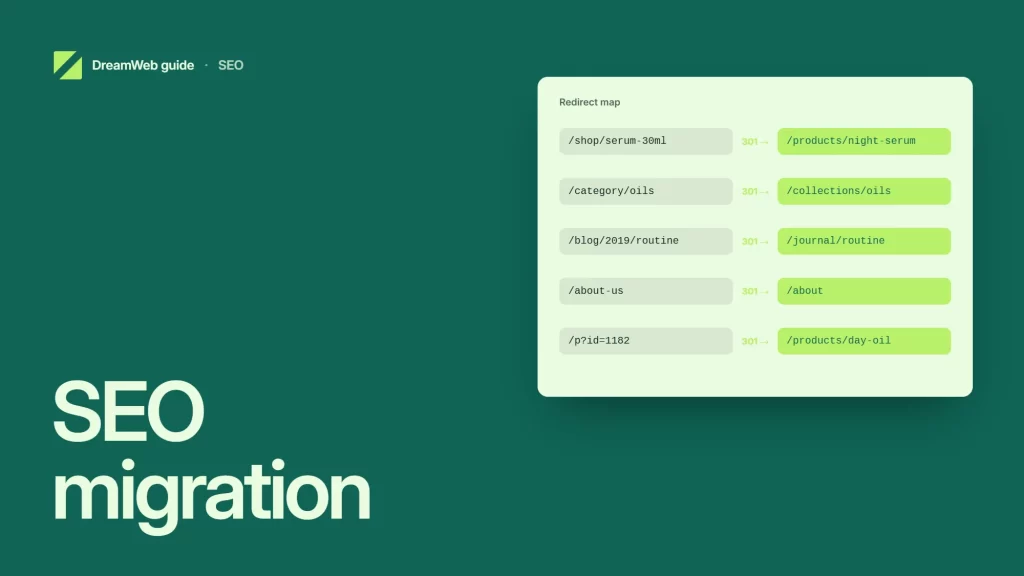
Build and test the redirect map
Map old URLs directly to final destinations. Avoid chains and loops. Include images, documents and campaign destinations when they carry traffic or links.
Test the rules in a staging or controlled environment before launch, then test the live responses again after release.
Protect on-page signals
Check titles, headings, useful copy, internal links, canonicals, structured data, robots rules and indexability. Redesigns often remove text or links because the new layout looks cleaner. That design decision can change what the page communicates.
Preserve measurement
Document analytics tags, consent behaviour, key events and Search Console verification. Run a baseline export before launch. A migration without comparable before-and-after evidence is difficult to diagnose.
Launch-day control
The consultant should work from a signed-off checklist with owners and rollback points. Checks include:
- important old URLs return one permanent redirect to the right new URL;
- new URLs return 200 and are not blocked or marked noindex;
- canonicals point to the final preferred URLs;
- internal links use new URLs rather than relying on redirects;
- the XML sitemap contains canonical, indexable URLs;
- analytics and key events fire correctly;
- Search Console verification remains valid;
- important templates render and work on representative devices.
Submit the new sitemap after the release. Google notes that a sitemap can help discovery, but it does not guarantee indexing.
What happens after launch
Monitor both the old and new estates. Look for redirect errors, 404s, soft 404s, unexpected noindex rules, canonical conflicts, sitemap failures, crawl changes and shifts in impressions, clicks and conversions.
Do not judge the move from one day of rankings. Compare page groups and queries against the agreed baseline, taking seasonality and other changes into account.
Google recommends keeping redirects for at least a year and notes that keeping them indefinitely can still help users. Update high-value internal and external links where possible so customers do not travel through a redirect forever.
Consultant, agency or developer?
A developer can implement rules and templates. An SEO consultant owns the search requirements, URL decisions, evidence and validation. A full migration agency may cover content, design, development and project management as well.
The right model depends on who already owns each area. What matters is that one named person can reconcile the entire migration and stop launch when a critical control fails.
What to ask before hiring
Ask:
- How will you find URLs that are absent from the crawl?
- Who decides whether pages are kept, merged or removed?
- How will redirects be tested before and after launch?
- Which baseline reports will be captured?
- Who owns canonicals, robots, sitemaps and structured data?
- What is the rollback threshold?
- How long is post-launch monitoring included?
- What will be delivered to our team?
Avoid any consultant who promises zero volatility or treats a redirect export as the whole migration.
DreamWeb’s website redesign brief includes URL inventory, redirects, analytics, Search Console and post-launch monitoring as named deliverables. Use it before proposals are priced, then talk to DreamWeb about the migration controls before the build reaches launch week.
Related reading: SEO audit services.