
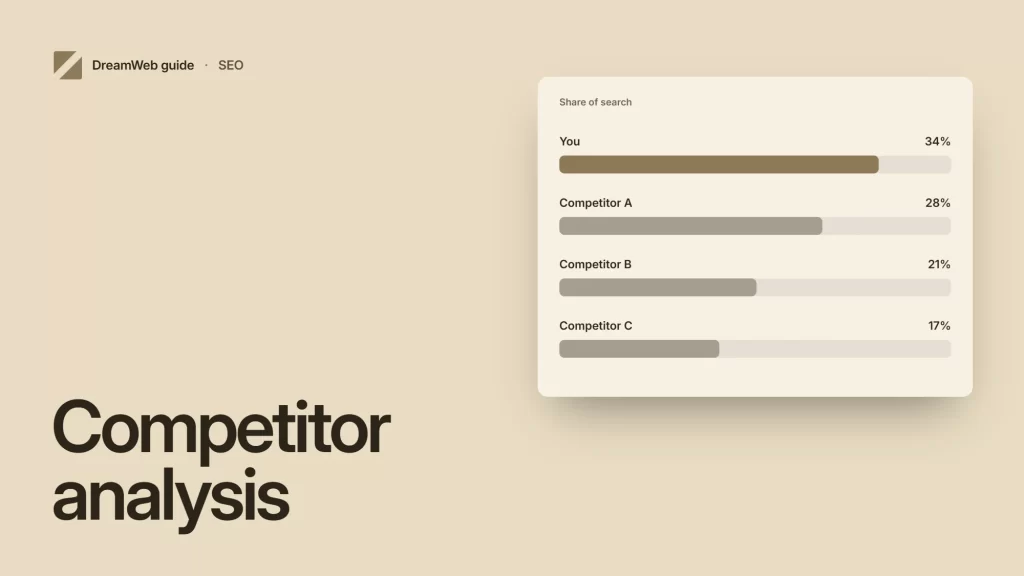
SEO competitor analysis services should explain why other pages win specific searches and what your site can realistically do about it. A list of domains with higher authority is not a strategy.
Your search competitors may not be your commercial competitors. Publishers, marketplaces, government guidance, forums and software platforms can own the result for different parts of the customer journey.
Start with the decision, not the tool
Define the question the analysis must answer. Examples include:
- Which service topics can this site credibly own?
- Why has a priority page lost visibility?
- Where are competitors satisfying the intent better?
- Which content gaps support revenue rather than traffic alone?
- Is the problem content, technical access, links or the offer itself?
Without a decision, competitor tools produce large exports and little direction.
What the analysis should compare
Search-result ownership
Map the domains and page types that appear for each intent. Record whether the result favours guides, service pages, tools, category pages, video or another format.
Page purpose and quality
Compare how quickly each page answers the query, its evidence, structure, depth, freshness, media and next step. Google Search Essentials emphasises helpful content and clear use of the words people search for in titles, headings and descriptive links.
Site architecture
Review how competitor pages are grouped and linked. A strong page may benefit from clear topical ownership and support, not only from its own copy.
Authority and proof
Look at relevant links, citations, brand demand, expert authorship, original tools, research and real-world examples. Do not reduce authority to one vendor metric.
Technical conditions
Check indexability, canonicals, rendering, structured data, performance and mobile experience. A content rewrite cannot fix a page that search engines cannot consistently access or understand.
Commercial fit
Record whether your business can genuinely serve the demand. A tempting keyword may require a product, location, price point or expertise that the organisation does not have.
A useful process
- Select priority intents tied to real services and journeys.
- Capture current search results for the target UK market and device.
- Identify the true competing pages, not only familiar brands.
- Compare page purpose, evidence, architecture and technical state.
- Audit your existing owners before proposing new URLs.
- Rank opportunities by relevance, difficulty, evidence and commercial value.
- assign one canonical owner to every chosen intent.
Keep observed facts separate from proposed actions. A competitor’s heading is observed. “We need a 2,000-word page” is a hypothesis.
What you should receive
Expect:
- a competitor and SERP-type map;
- query clusters with intent and current owner;
- page-level gap analysis;
- evidence and link comparison;
- technical blockers;
- keep, improve, consolidate or create decisions;
- a prioritised sequence with reasons;
- a source record and date for every live observation.
The deliverable should say what not to pursue. Restraint protects budget and prevents thin pages.
Common mistakes
Copying a competitor’s headings creates a weaker version of an existing result. Chasing every keyword creates overlap. Treating estimated traffic as revenue ignores lead quality. Comparing the homepage when the ranking page is a detailed guide answers the wrong question.
The better move is to find where your first-hand evidence changes the answer.
DreamWeb’s current content system uses one owner per intent and sequence based on measured demand, difficulty and site readiness. Before commissioning new pages, use the content audit approach to reconcile what already exists, or ask DreamWeb to build the competitor analysis around a real decision.
Related reading: SEO audit services and Content marketing strategy services.