
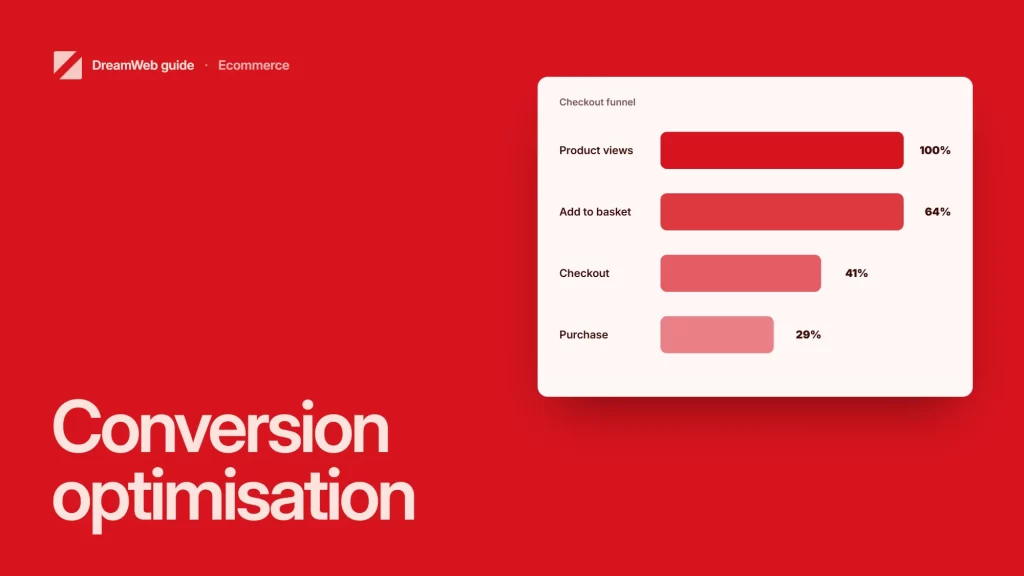
An ecommerce conversion optimisation agency should find where the buying journey loses qualified customers, explain why and test the smallest credible improvement. It should not install a stack of pop-ups and declare success from a short-term conversion spike.
Start with measurement quality
Before analysing the funnel, verify the events and commercial data. GA4 ecommerce reporting depends on events such as view_item, add_to_cart, begin_checkout and purchase, with the required item and transaction parameters.
Google’s ecommerce guidance recommends using DebugView for real-time validation because standard reports can take time to populate.
Check duplicate purchases, currency, refunds, consent behaviour, cross-domain checkout and the link between analytics and the order system. If the numbers cannot be reconciled, state the limitation.
What the agency should investigate
Customer and product context
Understand margin, repeat purchase, stock, promotions, delivery, returns and the questions customers need answered. A higher conversion rate on low-margin discounted orders may not improve the business.
Journey evidence
Review product discovery, search, filters, product pages, basket, checkout, payment and post-purchase. Combine funnel data with recordings where lawful, support contacts, surveys and usability testing.
Technical and accessible experience
Test speed, layout stability, keyboard use, error recovery, payment states, mobile interaction and third-party scripts. A hidden validation message can look like ordinary abandonment in analytics.
Offer and trust
Check whether price, delivery, returns, product evidence and payment expectations are clear at the moment the decision is made. Do not add generic trust badges where the missing information is specific.
A practical optimisation process
- Agree the commercial metric and guardrails.
- Validate the ecommerce data.
- Segment by journey, device, product and customer context.
- Research the largest credible friction points.
- Rank hypotheses by evidence, impact and effort.
- Fix obvious defects before experimenting.
- Run controlled tests where sample and risk justify them.
- verify revenue, margin and downstream effects.
- document the result and update the backlog.
Not every change needs an A/B test. Broken checkout tracking, inaccessible controls and factual product errors should be corrected. Experiments are for genuine uncertainty.
What you should receive
Expect a measurement audit, journey baseline, research evidence, prioritised hypotheses, experiment designs, implementation notes, QA, statistical approach and a record of wins, losses and inconclusive tests.
The agency should protect guardrails such as average order value, refund rate, support demand, performance and accessibility. Conversion alone can hide damage elsewhere.
How to choose the agency
Ask how it validates data, recruits users, controls tests, handles low traffic and separates correlation from causation. Request examples that include unsuccessful tests and what was learned. A supplier that only reports wins is showing a sales deck, not an experimentation record.
DreamWeb connects conversion work to the buying journey, analytics, usability and the platform constraints behind the interface. Pair CRO with website usability testing services when the cause is unclear, or ask DreamWeb to audit the buying journey and data first.
Related guides: Shopify SEO agency for the traffic that reaches the store, and headless ecommerce agency if the front end is the constraint.