
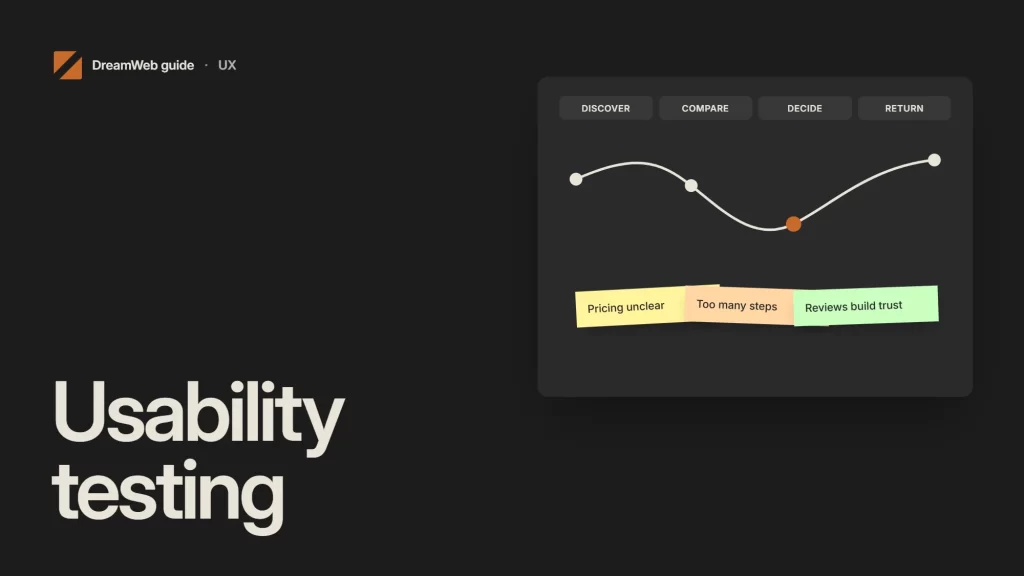
Website usability testing services observe real or likely users attempting realistic tasks. The purpose is to find where the website fails them, understand why and give the team evidence it can act on.
It is not a preference survey. Asking whether someone likes a design does not show whether they can use it.
When to run usability testing
Testing is useful during discovery, prototype work, development and live improvement. Run it when a journey is commercially important, assumptions are disputed, analytics shows a drop-off or a redesign needs evidence before build decisions harden.
GOV.UK’s moderated testing guidance describes watching participants complete specific tasks while thinking aloud. This exposes problems with language, layout and interaction.
A practical testing process
Define research questions
Agree what the team needs to learn now. Good questions are actionable: can a first-time buyer understand delivery before checkout? Can a user recover from a validation error? Avoid trying to test the whole website in one round.
Recruit relevant participants
Use actual or likely users with the characteristics that affect the task. Include access needs and device contexts relevant to the service. Four to eight participants can be appropriate for a focused qualitative round, with further rounds used to test changes.
Write realistic tasks
Give participants a goal without telling them which button or page to use. The scenario should feel credible and have a clear completion state.
Prepare and pilot
Check the prototype or live route, recording, consent, test data, accessibility and backup plan. Run a pilot before participant sessions.
Observe without leading
Remind participants that the service is being tested, not them. Ask neutral follow-ups. Record behaviour, words and outcome separately from the observer’s interpretation.
Analyse with the team
Group repeated evidence, identify root causes and rank findings by task impact, frequency and confidence. Turn them into owned changes and acceptance tests.
Test again
The first round finds problems. The next round shows whether the proposed change solved them.
What you should receive
Expect a research plan, recruitment criteria, discussion guide, consent approach, session evidence, findings, clips or quotes where permitted, prioritised recommendations and a clear record of limitations.
For repeatable improvement, establish stable tasks and measures such as completion, error rate, time on task and confidence. GOV.UK’s usability benchmarking guidance recommends combining performance measures with user research and repeating the process over time.
Remote, in-person or unmoderated?
Remote moderated testing is efficient and lets people use familiar devices. In-person work can reveal physical context and complex interactions. Unmoderated studies can reach more participants but give less opportunity to understand unexpected behaviour.
Choose the method around the question, risk and participants—not convenience alone.
A short buyer check
Keep the first test narrow. Pick one task that users must get right. It may be paying, booking, finding a fee or sending a form.
For example, give people the same short task and let them use their own words. Do not tell them where to click. What do they try first? What makes them pause? What makes them give up?
Ask to see the raw notes as well as the summary. You need the pattern, the context and the next test. A clip can be more useful than a slide full of red dots.
For instance, if people cannot find a delivery cost, ask them to find it rather than pointing at the menu. Consider what they say, not only the page they reach. Small detail can show the true cause.
Use UX audit services when you need a broader evidence review first, or ask DreamWeb to scope one focused round around the decision blocking the team.
Related reading: Ecommerce conversion optimisation agency.