
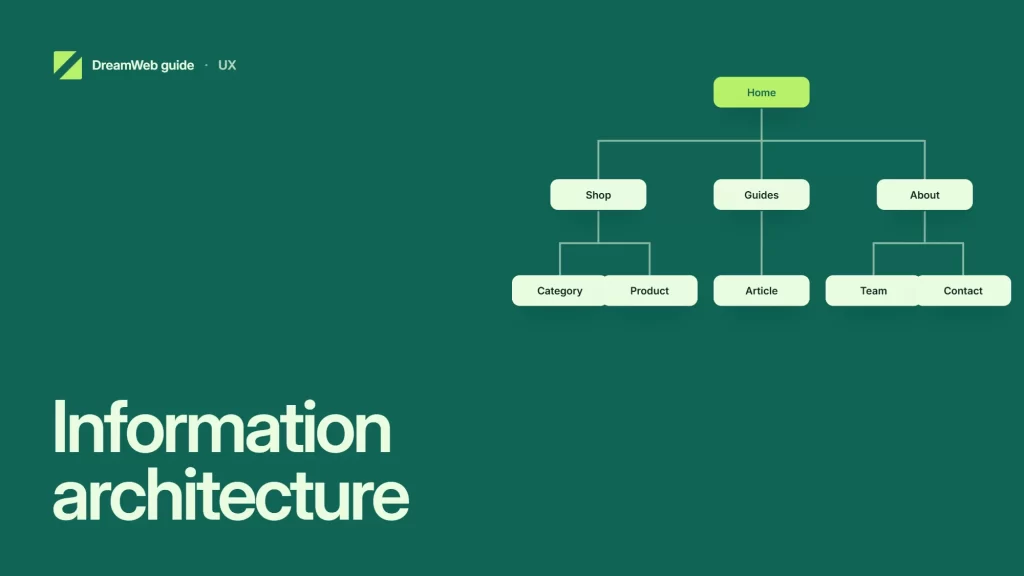
Information architecture services organise content so people can find, understand and move through it. The work covers page ownership, hierarchy, labels, navigation, relationships and the content model behind the interface.
A sitemap is one output. It is not the whole discipline.
When information architecture is the problem
Common signals include:
- navigation follows departments rather than customer tasks;
- several pages appear to answer the same question;
- users rely on search because browsing does not work;
- editors create new pages because they cannot find the owner;
- products or services cannot be compared consistently;
- a redesign is adding new structure without auditing the old estate;
- analytics show movement between pages but poor task completion.
What the service should include
Evidence and inventory
Combine content audit, search terms, analytics, user research, support questions and business rules. Record live, draft and proposed content separately.
User and business models
Understand the tasks people recognise and the data or services the organisation must manage. GOV.UK recommends scoping services as users see them rather than around organisational structures.
Page ownership and taxonomy
Assign canonical owners to important intents and define categories, attributes and relationships. Taxonomy should help users distinguish choices, not simply mirror internal terminology.
Navigation and labelling
Create clear global, local and contextual routes. Labels should predict the destination in language users recognise.
Prototyping and testing
Use card sorting where categorisation is uncertain, tree testing for findability and usability testing for complete journeys. Test with realistic content and participant tasks.
Governance
Document who can create new sections, how labels change, how overlaps are resolved and when content is reviewed. Without governance, the old structure returns.
What you should receive
Expect a content and page inventory, principles, taxonomy, sitemap, navigation model, URL recommendations, page types, test evidence, migration implications and governance rules.
The handover should show rejected options and trade-offs. A clean diagram without the reasoning is hard to maintain.
Architecture and SEO
Good architecture helps users and search engines understand which pages are important and how topics relate. Use descriptive internal links and avoid creating several near-identical routes for one intent.
A short buyer check
Choose five things people come to do. Find a quote. Read a guide. Check a fee. Buy an item. Get help. Then ask people to find each one without a link.
For example, where do they start? What word do they look for? Do two menu labels mean the same thing? Can they get back if they take a wrong turn?
Write down the terms that people use, not just the terms used inside the team. Test the new tree before a full design build. It is far cheaper to move cards than to move a live site.
Pair the work with content audit agency when ownership is unclear, or ask DreamWeb to map the estate before screens are redesigned.
Related reading: UX audit services and Customer journey mapping agency.