
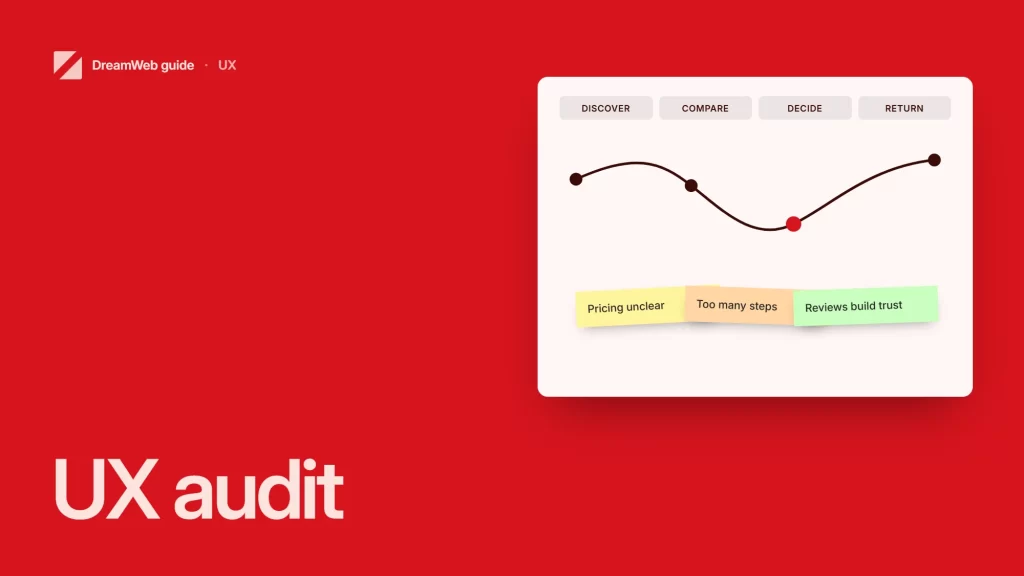
UX audit services should show where an interface makes a real task harder and what evidence supports the finding. They should not be a collection of personal preferences dressed as design rules.
The strongest audits combine behavioural data, expert review and observation of users completing representative tasks.
When a UX audit helps
Use an audit when customers abandon important journeys, support questions repeat, conversion falls, a redesign needs evidence or teams disagree about what to fix.
An audit is also useful before adding features. If people cannot complete the current task, more interface may create more failure.
What the audit should examine
The scope normally covers:
- priority audiences and tasks;
- navigation and information scent;
- content clarity and decision support;
- forms, validation and recovery;
- mobile and responsive behaviour;
- accessibility and keyboard use;
- page speed and interaction feedback;
- trust, privacy and commercial friction;
- analytics events and funnel evidence;
- internal workflows that affect the customer experience.
The auditor should follow complete tasks rather than grading isolated screens.
Three evidence layers
Analytics and operational data
Funnels, events, search terms, device patterns, support tickets and sales objections show where problems may exist. They do not explain intent on their own.
Expert review
An experienced reviewer can identify inconsistent patterns, unclear hierarchy, poor feedback, accessibility barriers and avoidable cognitive load quickly. This is efficient, but still a hypothesis until supported by user or behavioural evidence.
Usability testing
GOV.UK defines moderated usability testing as watching participants try to complete specific tasks while explaining what they do, think and feel. It reveals problems that a static review misses.
Use likely users, realistic tasks and representative devices. Tell participants you are testing the service, not them.
A practical audit process
- Agree the business outcome and tasks in scope.
- Validate the analytics and evidence available.
- Review the live journeys across devices and states.
- Test the highest-risk assumptions with users.
- Group repeated findings by underlying cause.
- Rank by user impact, business impact, confidence and effort.
- Turn recommendations into owned work and acceptance tests.
Each finding should include evidence, affected journey, severity, recommendation and verification method.
What you should receive
A useful handover includes:
- scope and evidence limitations;
- task and journey map;
- annotated findings with reproduction steps;
- clips, quotes or observations where consent allows;
- a prioritised backlog;
- quick fixes separated from structural work;
- prototype or content recommendations where needed;
- measures for the next test round.
Avoid reports that prescribe a complete redesign without testing whether smaller changes solve the problem.
Measuring improvement
Track task completion, error rate, time on task, support demand, qualified conversion and accessibility defects. GOV.UK’s usability benchmarking guidance recommends combining performance measures with repeated user testing.
The aim is not to produce a perfect score. It is to make important tasks measurably easier.
A short buyer check
Pick one user task. Keep it real. It might be finding a fee, booking a slot or paying for an item. Then watch a few people try it.
For example, note where each person stops, what they say, what they click and what help they need. Does the same problem show up more than once? Is it on more than one device? That is useful evidence.
Ask for clear clips or notes, not a long list of taste-based changes. You need to know what to fix first and how you will tell if the fix worked.
Use customer journey mapping when the problem crosses teams and channels, or ask DreamWeb to scope a focused UX audit when the failing task is already clear.
Related reading: Website usability testing services and Web accessibility agency.